

The January window: what sells in the first two weeks
New Year demand is real, it is short, and most sellers arrive after it has gone. What people buy in early January, how big the lift is, and the dates that decide it.
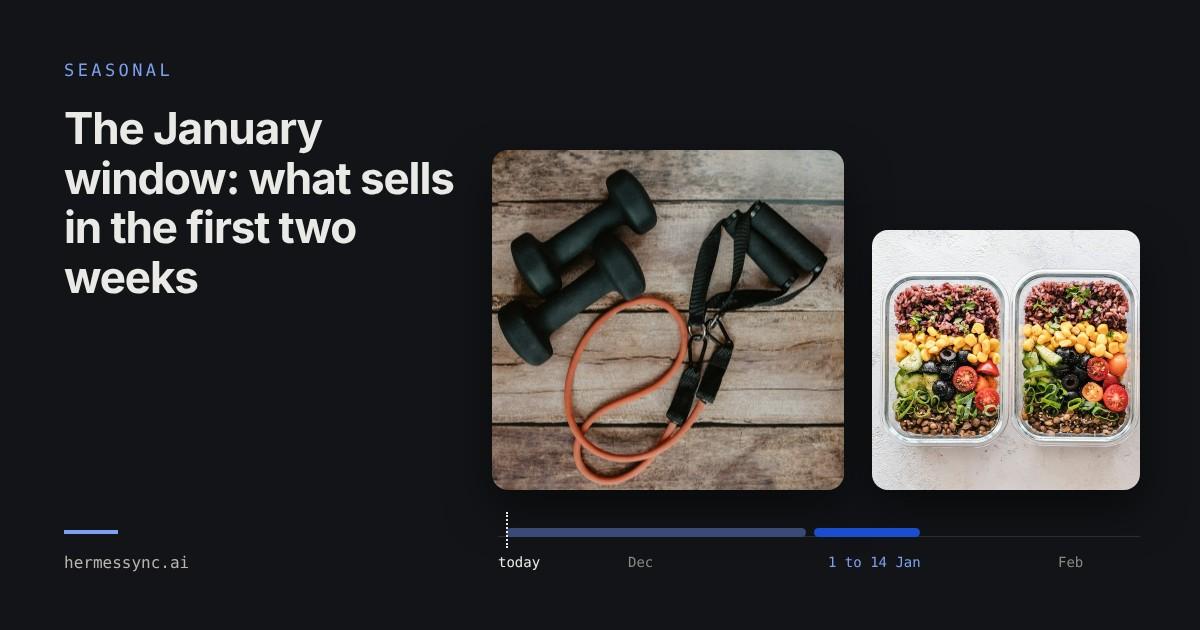
Every January, a large number of people decide to change something about their lives, and a good share of them buy something to help. A set of weights. Food containers. A planner.
That buying happens fast and it stops fast. Most sellers are still clearing up after Christmas when it starts, and by the time they have a product live, the people who were going to buy have already bought.
This post covers what those people buy, how big the lift is, and the handful of dates that decide whether you catch it. If you read the Q4 calendar, this is the window that post called open and underrated, in detail.
What people decide to change
YouGov asked 1,104 American adults in December 2025 what they planned for the year ahead. About three in ten said they would make a resolution, and these five goals led the list.
Read as a shopping list, that is four product families:
| The goal | What people buy to start |
|---|---|
| Exercise more | Small home fitness kit: weights, bands, mats, anything that fits in a flat |
| Eat healthier | Food containers, portion tools, blenders, kitchen gadgets that make cooking quicker |
| Save money | Planners, budget binders, savings challenges |
| Feel better | Journals, sleep and comfort products |
None of this is a secret, which is the point. The demand comes back every year on the same date. What changes each year is which specific product inside each family is the new one.
How big the lift is
Jungle Scout measured Amazon sales over roughly the two months to mid January 2024 against the two months before. These are the categories it reported.
Two cautions on reading that chart. It is Amazon in the United States and it is two winters old, so treat it as the shape of the season, not a forecast for your store. And the biggest machines in it are not yours to sell. The useful part is everything else: journals, planners, mats and the lighter end of weight training all rose, and all of them travel as an ordinary parcel.
An older study by Pattern, covering Amazon from 2019 to 2021, found the same shape. Strength training equipment and planners each ran 53% higher in January than across the rest of the year, and planner demand started climbing in December, before the year turned.
That last detail matters more than the percentages. The buying starts before 1 January.
Why it is over so quickly
People buy at the moment they decide, and the deciding is concentrated in a few days. Then real life comes back.
Strava looked at 31.5 million logged workouts and found the day people are most likely to drop a new exercise habit: the second Friday of January. It has been known as Quitter's Day ever since. In 2027 that is Friday 8 January.
Strava measures exercise, not shopping, so it is a stand-in and not a sales figure. It is still the best public marker of when the motivation runs out, and motivation is what you are selling into. Someone who has already given up on the gym is not buying resistance bands.
So the window is not January. It is roughly the last days of December and the first two weeks of the new year.
The dates, worked backwards
Working back from 1 January:
Late December to about 10 January is when the money is made. By then the product has to be chosen, the page has to be built and the ads have to know who they are looking for. None of that can be done in the window itself.
December is for settling in. A new campaign spends its first stretch learning who responds. You want that finished before Boxing Day, not starting on it. There is a helpful side to this month too: TikTok says its own advertising prices fall through December and January compared with the November peak. It gave no figure, so take it as a direction and not a discount you can bank.
The second half of November is for choosing and testing. That is now. Black Friday on 27 November makes that one weekend an expensive time to buy attention, so test small around it and keep the budget for later.
Delivery time counts double. A Christmas gift that arrives late is a refund. A resolution purchase that arrives three weeks late lands with someone who has already quit. If your supplier's delivery estimate is long, the window is shorter for you than the chart shows.
The date most people miss
Chinese New Year falls on Saturday 6 February 2027. That is eleven days earlier than this year.
Factories and suppliers in China do not stop on the day. According to the freight firm Seko Logistics, many start reducing output several weeks beforehand, and a good number run short-staffed into March.
Put that next to the January window and there is a trap in it. A product that takes off on 2 January needs more stock by the middle of the month, which is just when the people who make it are winding down. The seller who did well is the one who runs out.
Two things to do about it, both in December:
- Ask your supplier for their holiday dates in writing: last day for orders, last day for shipping, first day back.
- Find out how much stock they hold before you scale, not after.
How to pick inside a family
"Fitness" is not a product. Plain resistance bands come back every January and so do a thousand sellers offering them. The family tells you where the demand is. It does not tell you which product still has room.
What to look for is the version that is new this year. One that people are starting to post about and that few sellers are advertising yet. In the terms of the four phases, you want something untapped or early in scaling at the start of December, because it will have moved along a phase by January whether you are in it or not.
| Check | Good sign | Bad sign |
|---|---|---|
| Who is posting about it | A growing number of creators | The same few videos recycled |
| Who is advertising it | Few or no advertisers yet | Dozens of near-identical ads |
| Size and weight | Fits in a mailing bag | Needs a box and a courier |
| Delivery estimate | Arrives inside two weeks | Arrives after the 8th |
| Supplier stock | Depth confirmed before the holiday | "We can make more" in late January |
The first two rows are the ones that go out of date. A product can pass both on Monday and fail both a fortnight later, which is the argument in why winning product lists are already late.
What to do this week
- Pick one or two of the four families. Not all of them.
- Shortlist products inside them that are new this season, and check who is posting and who is advertising.
- Order a sample of anything you are serious about. It also tells you the real delivery time.
- Get your supplier's Chinese New Year dates in writing.
- Have the page built and the first small test running by the end of November.
The demand will turn up on its own. It does every year. The only question is whether your product is already there when it does.
HermesSync scores products daily on how fast they are spreading on TikTok and how many advertisers are already running them, labels where each one sits in its cycle, and builds the Shopify product page when you have chosen. See what it finds.
Sources
- YouGov, Americans' New Year's resolutions for 2026, surveyed 9 to 11 December 2025.
- Jungle Scout, New Year's resolution product trends, January 2024.
- Pattern, The market impact of New Year's resolutions, December 2021.
- Strava's drop-off analysis, as reported by Cycling Weekly, January 2018.
- Seko Logistics, Chinese New Year 2027: shipping and factory closure deadlines.
- TikTok's statement on advertising prices, as reported by PPC Land, November 2026.