
Why winning product lists are already late
A product has to prove itself before anyone will put it on a list. That proof is the same thing that closes the window. Here is the sequence, and where the lists land in it.
Search for winning dropshipping products and you will find no shortage of lists. Twelve for Christmas, twenty for pets, thirty for beauty. They are well made, they are updated every year, and they are read by a very large number of people.
That last part is the problem.
This is not an argument that the lists are wrong. The products on them usually are selling. It is an argument about when you are being told, and what has to happen before anyone can tell you.
A product has to be provable before it is publishable
Put yourself on the other side of the article. You are writing a product list and you need every pick to hold up. A reader who tries one and finds nothing there does not come back.
So you need evidence. Sales rank, visible ad spend, review counts, creators already posting it, a few stores already running it profitably. You pick products that have already demonstrated they work.
Now follow what that requirement implies. For a product to show that much evidence, a lot of people have to have found it first, built pages for it, and spent money on traffic. The evidence is not a leading indicator of opportunity. It is a record of an opportunity other people already took.
By the time a product is safe enough to publish, it is crowded enough to be hard.
The sequence
Products move through roughly the same four stages, and they move through them in order.
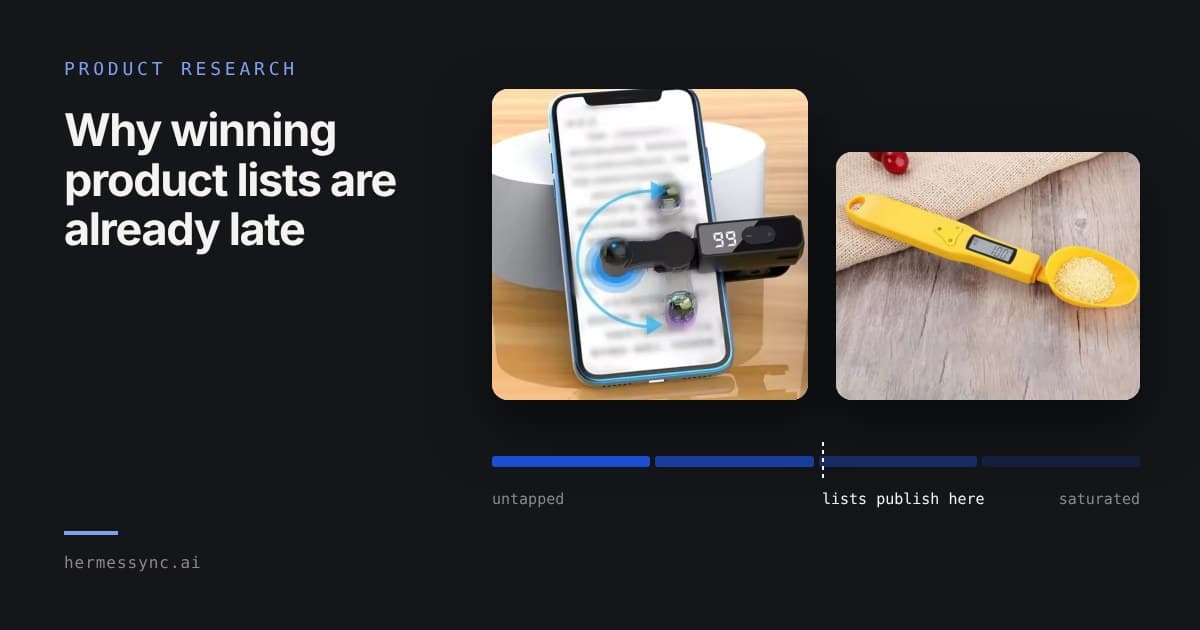
Schematic, not measured data. It shows the ordering of the phases, not the duration of any particular one.
Untapped. A handful of creators are posting it, usually because a supplier or an affiliate programme seeded it. Organic views are climbing fast from a small base. Almost nobody is running paid traffic. There is no evidence a list could use, because there is barely any evidence at all.
Scaling. More creators pile in, because they can see it working for the first group. Views accelerate. The first media buyers notice and start testing. Ad costs are still reasonable because the auction is thin.
Saturating. Advertiser count climbs steeply. Creative gets recycled. CPM rises. This is the earliest point at which a product has enough public proof to be worth writing about.
Saturated. Attention flattens or declines while advertiser count stays high. Margin goes to whoever has the best fulfilment and the deepest pockets.
The window is in the first two phases. The evidence needed to publish arrives in the third.
The gap is weeks, not months
This matters because the distance between phases is short.
Organic attention and advertiser count do not move together. Creators move first, because posting costs them nothing but time. Media buyers move second, because spending money requires more confidence. The lag between those two is where the opportunity lives, and in our own pipeline it is usually a matter of weeks.
That is also roughly the time it takes to research, write, edit and publish an article. Which is part of why the lists land where they do. It is not carelessness. It is the publishing cycle running at the speed of publishing while the market runs at the speed of TikTok.
What this means practically
It does not mean ignore the lists. It means read them for a different purpose than the one implied.
A published list is a good map of what has already worked. That is genuinely useful. It tells you which categories have demand, what price points clear, which angles convert, and what a proven page looks like. Treat it as market education.
What it is not is a buy signal. If the list is the first time you are seeing a product, you are behind everyone who found it through the evidence the writer used.
So the practical move is to work one layer upstream of the list:
- Watch the rate of change in organic attention, not the cumulative total. A product at 300,000 views climbing fast is a better prospect than one at two million that has flattened. Cumulative counts only tell you something happened.
- Watch creator count against advertiser count. When the first is climbing and the second is flat, you are inside the window. When both are high, you are reading a list.
- Treat visible competitor ads as confirmation that the window is closing, not as proof that it is open.
We wrote about the specific signals and the order they move in, in how to tell a product is saturating before your CPM does.
Where this leaves the lists
They will keep being published and they will keep being read, because they answer a real question and because the alternative, until recently, was nothing.
The alternative now is measurement. The signals that a list uses as evidence are observable before they add up to proof, if something is watching continuously rather than at publication time. That is a difference in instrumentation, not in insight.
The honest summary is this: a list tells you what was true when it was written. For a market that turns over in weeks, that is a meaningful gap, and it is the whole reason the window exists for anyone at all.
HermesSync scores products daily against TikTok velocity and live advertiser counts, and labels where each one sits in the cycle above. See what it finds.