
Dropship.io alternatives: what to compare them on
Most comparisons count features. The two things that decide whether a research tool earns its subscription are what it measures and which plan that measurement is on, and the second one is where the surprises are.
People usually start looking for an alternative to Dropship.io for one of three reasons. The entry plan is $39 a month, and the $26 figure you see first is the annual rate. The research ends at a shortlist, and the rest of the work is still yours. Or the library is large and the question of which product to actually pick has not got any easier.
Whatever sent you looking, the comparison you are about to do is probably the wrong one. Feature checklists in this category are nearly identical, because everyone has a product database, a trend feed and some ads data. What separates these tools is narrower than the checklists suggest, and it comes down to two questions.
The first question: what does it actually measure?
Almost every tool in this space will show you a product with a number attached. The number is where they differ, and the difference matters more than anything else on the page.
Cumulative totals are the easy thing to compute and the least useful thing to read. Total sales, total views, total orders. They tell you something happened. They cannot tell you whether it is still happening, which is the only thing you need to know before spending money. A product sitting at two million views might be climbing or might have stopped six weeks ago, and the total looks identical either way.
Rate of change is the harder thing to compute and the thing worth paying for. How fast attention moved this week against last week. That is a different question, and it is the one that separates a window from a leaderboard.
Competition is the signal most tools leave out entirely. Not how many sellers exist, but how many advertisers are bidding on the product right now. You can be early on attention and late on the auction at the same time, which is the specific situation that drains an ad budget while every dashboard still looks green. We wrote about that in how to tell a product is saturating before your CPM does.
Where it sits in the cycle is the fourth. Some tools give you a saturation score folded into one number. That is better than nothing and worse than a label you can act on, because a single score cannot be taken apart. The four phases of a product sets out what a label has to tell you to be useful.
The second question: which plan is it on?
This is the one nobody checks, and it is where comparing entry prices goes wrong.
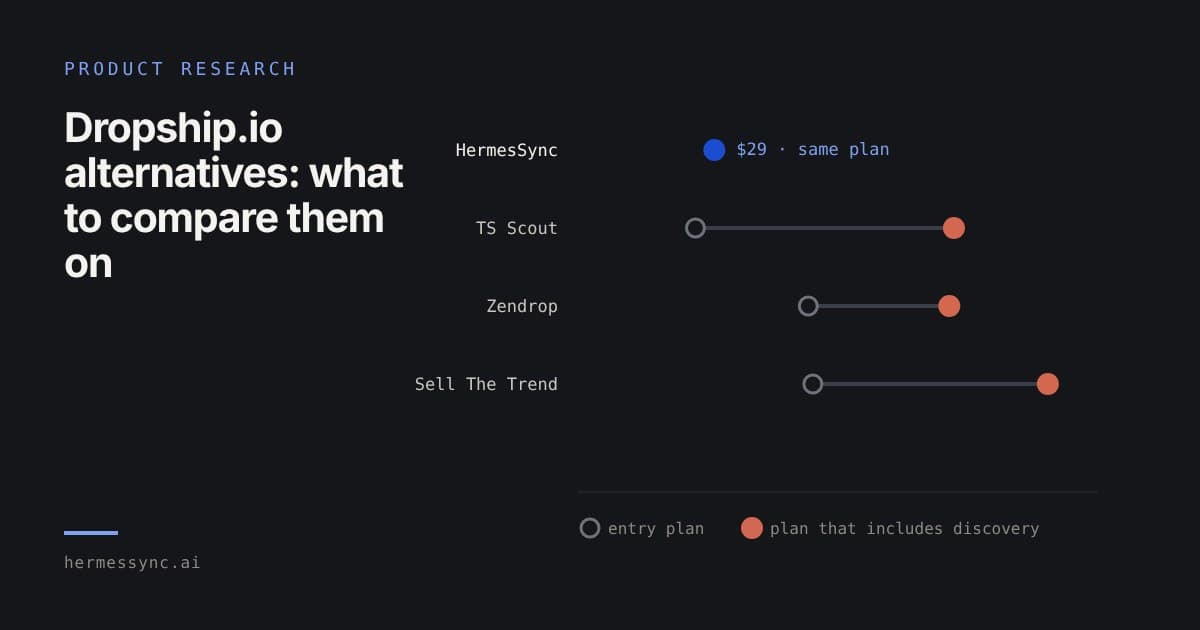
The headline number on a pricing page is the cheapest way into the product. It is often not the cheapest way into the thing you came for. Across the tools we have compared in detail, the pattern turns up often enough to be worth checking every time.
Read from each tool's own pricing page between 28 October and 1 November 2026. Prices move, so check before you buy.
On TS Scout, the entry plan is $24.99 and the TikTok trend discovery is on Premium at $79.99. On Zendrop, the $49 plan covers fulfilment and unlimited orders, and the Top Winning Products feed arrives on Plus at $79. On Sell The Trend, Essential at $49.97 carries the Facebook ads finder but not the TikTok Shop or TikTok viral finders, which are on Pro at $99.97.
None of that is hidden. It is all printed on their pricing pages, in grey rows that are easy to skim past when you are comparing the big numbers at the top. But it means an entry-price comparison can be out by fifty dollars a month before you have tested a single product.
Dropship.io itself does not do this. Research is the product, so it is on the plan you buy. What to check there instead is which rate you are being shown: their pricing page opens on the annual toggle, so $26 a month is a year's commitment at $312 up front, and the monthly price is $39.
What to actually compare
Five questions, in the order they matter.
| Question | Why it decides anything |
|---|---|
| Rate of change, or cumulative totals? | Totals describe the past. Only the rate tells you whether the window is open |
| Does it count advertisers, not just sellers? | You can be early on attention and late on the auction at the same time |
| Does it label where the product sits in its cycle? | A single saturation score cannot be taken apart or acted on |
| Does it end at a shortlist, or take you to a page? | Research that stops at a list leaves the expensive half on your desk |
| Which plan carries the thing you came for? | See above. This is where fifty dollars a month hides |
Two of those are about measurement and three are about what happens afterwards. Most comparison articles cover neither, because counting features is easier and reads as more thorough.
Where this lands
We built HermesSync because the answer to question four was almost always "a shortlist". Finding the product is the part everyone sells, and building the page is the part that eats the week.
So HermesSync scores on rate of change rather than totals, labels every product with one of four phases, counts the advertisers already bidding, flags the case where those two signals disagree, and then writes and publishes the page. Discovery is on every paid plan, starting at $29. There is no higher tier you have to reach to see the thing the product is for.
What it does not do is fulfilment, warehousing or multi-platform selling, and several tools in this list do. If parcels are your bottleneck rather than decisions, that matters more than anything above.
We keep a detailed comparison for each of these, with every price read from their own page and dated:
- HermesSync vs Dropship.io
- HermesSync vs Sell The Trend
- HermesSync vs Zendrop
- HermesSync vs TS Scout
- HermesSync vs AutoDS
- HermesSync vs Tradelle
The short version
Do not compare libraries. Every tool has one and the overlap is enormous.
Compare what the number on the product actually measures, and compare the price of the plan that has it rather than the price on the banner. Those two checks take about ten minutes across any shortlist and they are the only part of the decision that changes what you earn.
HermesSync scores products daily on velocity and live advertiser counts, labels the phase, and builds the Shopify page. See what it finds.